
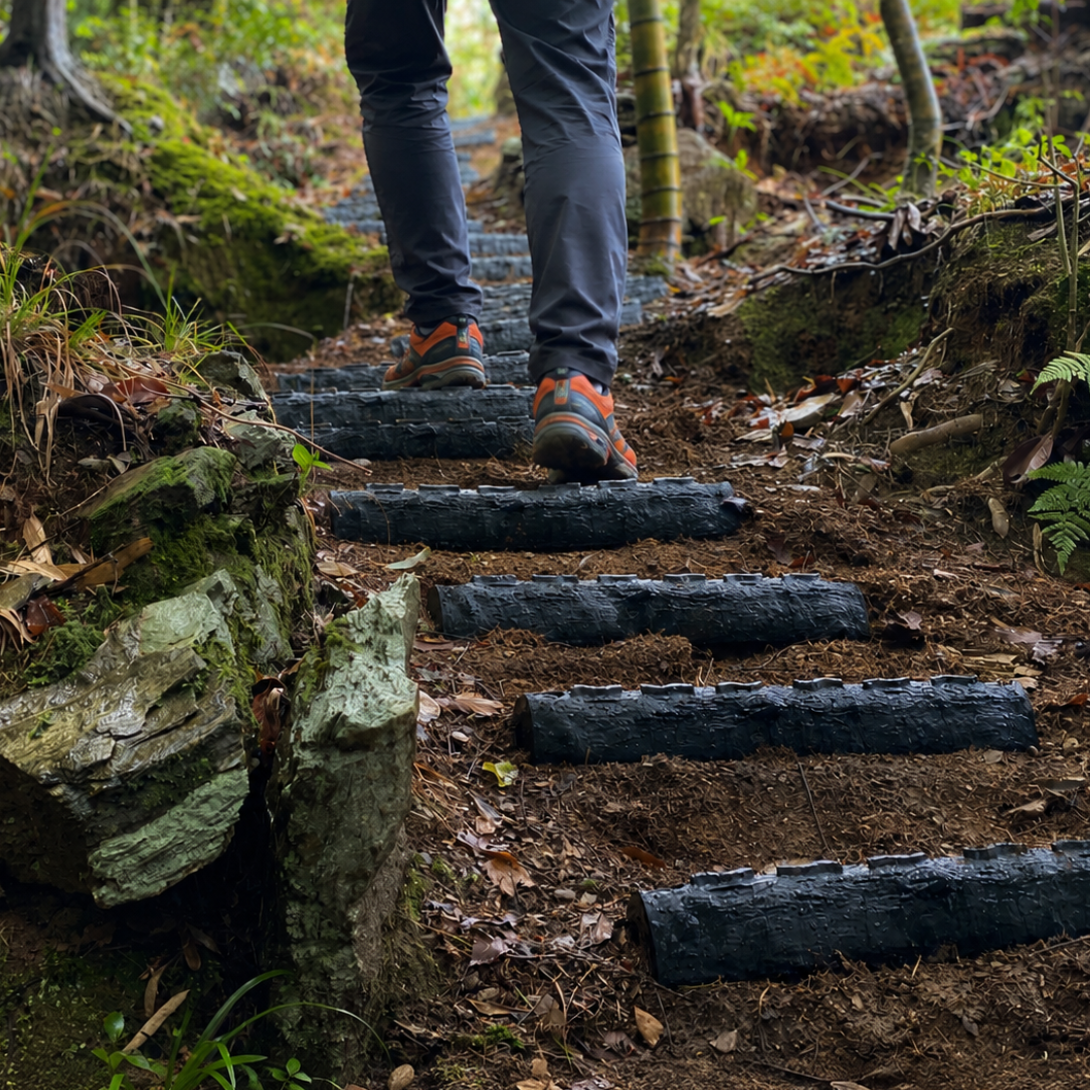
A staircase that looks good is not always a staircase that feels good to walk on
Have you ever walked on hillside stairs or trail steps and felt that something was strangely uncomfortable?
- Your walking rhythm keeps getting interrupted
- You end up stepping down with the same foot over and over
- The pace feels awkward
- Descending feels tiring
- Downhill sections feel unstable or stressful
This happens more often than people realize.
And in many cases, the reason lies in how the staircase itself was designed and constructed.
Humans naturally walk with rhythm
When we walk, our bodies naturally move in a steady rhythm:
Right, left, right, left...
That rhythm exists not only on flat ground, but also on slopes and mountain trails.
Especially when walking downhill, maintaining a natural cadence becomes extremely important for comfort and stability.
However, many hillside stair systems unintentionally disrupt that rhythm.
Why are so many slope stairways difficult to walk on?
One major reason is that many traditional stair systems are designed around the idea of excavating the slope first.
Typical hillside stairs are often built by:
- Digging into the slope
- Creating flat horizontal surfaces
- Forming stair steps from those cut sections
But natural terrain is rarely uniform.
Even within a short distance, slopes constantly change:
- around 25° in one section
- over 40° in another
- sometimes approaching 45°
Nature does not create perfectly consistent angles.
So when builders try to force a natural hillside into evenly leveled stair geometry, compromises happen.
“Covering more distance per step” often destroys natural walking rhythm
Building hillside stairs is difficult and labor-intensive.
As a result, many stair designs try to reduce the total number of steps by making each tread longer or wider.
Visually, this may look neat and organized.
But when you actually walk on those stairs, problems appear:
- You need to take half-steps or extra adjustment steps
- One foot keeps repeating unnaturally
- Your stride no longer matches your natural pace
- Your walking rhythm gets interrupted
In other words:
A staircase can look beautiful while still being uncomfortable to walk on.
NOBOROKKA is designed to work with natural terrain
NOBOROKKA was designed with these walking rhythm issues in mind.
One of its biggest differences is this:
It can be installed while preserving the natural slope itself.
Instead of heavily reshaping the terrain, NOBOROKKA adapts to it.
That flexibility allows it to work across a wide range of natural hillside conditions, including:
- gentle 25° slopes
- steeper 30°+ inclines
- challenging 40°–45° terrain
Even when the angle changes continuously along the path.
Designed to preserve natural walking cadence
NOBOROKKA is not based on the idea of forcing nature into perfectly flat geometry.
Instead, the design philosophy is closer to this:
Rather than forcing people to adapt to the staircase,
the staircase adapts to the natural rhythm of human movement.
This helps create a walking experience that feels:
- smoother
- more natural
- easier to maintain rhythm on
- less tiring during descents
- more comfortable over long distances
And in real-world use, that difference becomes surprisingly noticeable.
The goal is not simply to build stairs — but to create a path people can walk comfortably
For hillside stair systems, simply “having steps” is not enough.
What truly matters is whether people can:
- walk safely
- move naturally
- maintain comfortable rhythm
- reduce fatigue
- coexist with the surrounding landscape over time
That is why NOBOROKKA focuses on preserving the natural terrain instead of aggressively reshaping it.
It is a design philosophy shaped through more than 50 years of experience working with hillside access and outdoor slope pathways.

Leave a comment
This site is protected by hCaptcha and the hCaptcha Privacy Policy and Terms of Service apply.